Rethinking Scale: From Human Coordination to On-Device Intelligence
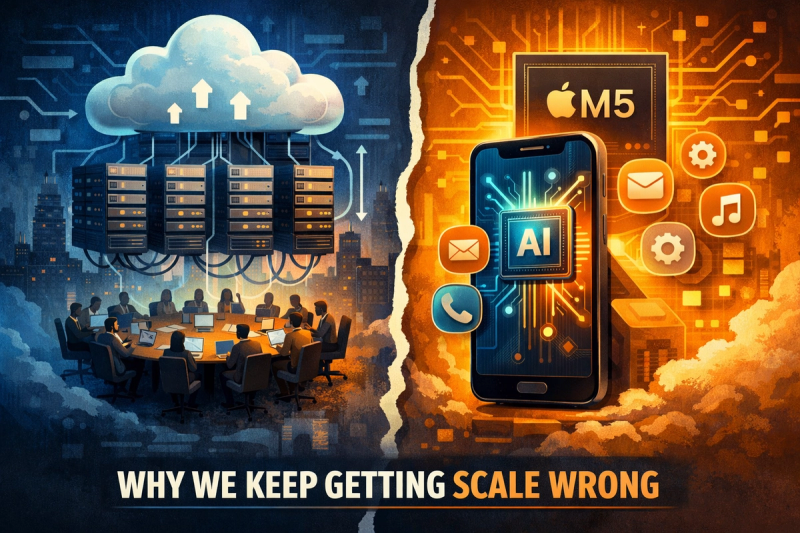
I spent decades watching companies throw money at "scale problems" that weren't actually scale problems.
More servers. More engineers. More coordination meetings about the coordination meetings. We'd architect beautiful systems that could handle ten million users—for products that had twelve.
Here's what I learned the expensive way: Scale is not about traffic, infrastructure, or microservices. Scale is about whether a system can continue to operate correctly as cognitive load, coordination complexity, and decision volume increase—without requiring more humans.
That distinction matters. A lot.
This isn't theoretical. It's the precise architectural logic driving the most significant strategic pivot in personal computing right now: the shift toward powerful, on-device AI.
Why We Keep Getting Scale Wrong
The conventional engineering definition of scale defaults to infrastructure and cloud architecture. Handle more requests. Spin up more instances. Optimize database queries. Ship it.
I lived this for years. We'd design systems assuming the bottleneck was compute. Then we'd discover—painfully—that the real bottleneck was humans trying to coordinate across the complexity we'd built.
Apple's "Apple Intelligence" strategy is a perfect case study of someone finally getting this right.
The traditional cloud-heavy approach to AI is exactly how we've always thought about scaling software: throw more compute at the problem in a distant data center. But Apple's "on-device first" approach—supported by their Private Cloud Compute infrastructure—addresses a critical blind spot: the coordination and decision continuity required to maintain a user's private context.
This strategy helped propel Apple to a $4 trillion market capitalization. That's not a rounding error.
The new bottleneck isn't just coordination overhead between humans. It's the complex, high-latency coordination between our devices and the cloud—a round-trip that compromises both continuity and privacy.
Scale as a Systems Problem: The On-Device Analogy
The core challenges of scale can be framed using systems theory language. Apple's AI ecosystem provides a concrete analogy for each concept.
Managing state over time. A scalable system must maintain context. This is precisely what Siri's "Onscreen Awareness" and "App Intent" features do. By understanding user context across different applications, the system manages continuous state—enabling complex, multi-step commands that were previously impossible.
Enforcing a single version of truth. On-device processing ensures that personal data—emails, documents, calendars, messages—remains local. One secure source of truth that never has to leave your device. No cloud sync. No data integrity risks.
Preserving decision context. An "on-device first" approach keeps sensitive personal context local by default. This isn't merely a privacy feature. It's a core tenet of a scalable system that can make intelligent decisions without the latency and security compromises of fetching context from a remote server.
Preventing drift. The Private Cloud Compute infrastructure is explicitly designed to prevent sensitive user data from drifting into the cloud. It operates on a "stateless" model where user data is wiped the moment a request is fulfilled—a claim independently verified by security researchers in 2025. No divergent, insecure, outdated versions of your truth sitting on remote servers.
Hitting the Wall: From Cloud Latency to Local Parallelism
Every founder eventually hits a wall. Most people frame this as burnout. I see it differently: it's a systemic failure of architectures that don't actually scale.
Serial vs. Parallel Execution. A cloud-centric workflow is inherently slow and serial. Each step in a complex task requires a round-trip to a data center. Wait. Process. Return. Repeat.
The Apple M5 chip flips this. Massive parallel processing, locally. Its GPU cores contain dedicated Neural Accelerators that handle enormous AI compute tasks on-device, delivering what feels like zero latency. This isn't just a hardware upgrade—it's a direct architectural answer to cloud-first scaling's systemic flaws.
Backpressure and Bottlenecks. Cloud API fees, network latency, data egress costs—these are all forms of systemic backpressure. "Just work harder" by making more API calls fails because the true bottleneck is memory bandwidth between the model's parameters and the compute engine.
Just as adding more people to a broken process creates coordination chaos (ask me how I know), making more API calls against a memory-bottlenecked system yields diminishing returns. The problem isn't the number of workers. It's the width of the pipe.
The M5 chip addresses this directly: a 30% increase in unified memory bandwidth to 153 GB/s. Widening the pipe where it matters.
Distributed Systems Complexity. The traditional client-cloud model is a complex distributed system with inevitable privacy and coordination failures baked in. The modern, scalable approach simplifies this by moving computation to the edge—running directly on the user's device.
Anatomy of a Scalable Operating System
A truly scalable system manages state, coordinates tasks, and adapts to changing demands. Apple Intelligence's architecture makes this concrete.
Orchestration, Not Monoliths. Architecturally, Apple Intelligence functions as an AI Orchestrator—a control plane for routing intelligence, not a monolithic model. Its Multi-AI Platform doesn't rely on a single solution. Instead, it intelligently routes tasks to the best tool for the job: OpenAI's ChatGPT-5 for world-knowledge queries, Google's Gemini for search, Anthropic's models for specific interactions.
This is what good architecture looks like. Specialized tools, intelligently coordinated.
Durable State and Bounded Autonomy. The user's personal context is durable state, held securely on-device. This enables agentic AI to perform multi-step, autonomous tasks like: "Find the contract Sarah sent me on Slack and draft a summary."
But—and this matters—that autonomy is bounded. Constrained by user intent and strict privacy rules enforced at the operating system level. Not a free-for-all.
Control Planes and Feedback Loops. The hybrid on-device/PCC architecture functions as a sophisticated control plane. If a task is too complex for local execution, the on-device system escalates it to Private Cloud Compute. A feedback loop that balances computational power with user privacy, using the most efficient resource for each job.
Governance, Not Autopilot
Let me be clear: this new model of scale is about governance, not replacing human judgment. It augments human capability. It doesn't create a hands-off autopilot.
Apple's strategy makes this explicit. Apple Intelligence is described as an "ambient utility" and a "digital concierge"—not an autonomous entity. The system enforces oversight and accountability.
In a rare move for a major tech company, Apple publishes every production PCC server build for public inspection and cryptographic attestation. As AI ethicist Dr. Elena Rossi noted: "Apple has created a blueprint for how generative AI can coexist with civil liberties."
This focus on governance directly addresses AI hallucinations—the industry-wide challenge that keeps founders up at night. In any scalable system capable of autonomous action, ensuring the system remains a reliable source of truth is the most critical function.
Why This Is Feasible Now
This isn't science fiction. It's the result of tangible technological shifts converging at the right moment.
System Composition. Apple can compose a complete system from its own foundation models, specialized silicon, and integrated third-party models from partners like OpenAI and Alphabet. Vertical integration that actually delivers.
Efficient and Powerful Silicon. The Apple M5 chip—fabricated on a third-generation 3nm process—is the engine. Key architectural shifts: Neural Accelerators integrated into each GPU core, unified memory bandwidth of 153 GB/s. Designed specifically for local AI demands.
Mature Small Language Models. The rise of highly capable SLMs—Qwen3-VL-8B-Thinking, Microsoft's Phi-4-mini-instruct, Google's Gemma-3-12B—optimized for on-device deployment is a critical enabler. Intelligence doesn't require monolithic scale. It can be specialized, efficient, and distributed. Precisely the characteristics needed to offload cognitive work without creating massive, centralized dependencies.
Favorable Cost Curves. On-device AI offers a zero inference cost model for developers—computation happens on user-owned hardware. For enterprises, this dramatically lowers total cost of ownership by reducing cloud GPU spend and data egress fees.
The Shift That Matters
For thirty years, I watched the industry default to "more cloud, more servers, more complexity" as the answer to every scaling question.
That answer was often wrong. We were solving infrastructure problems when the real constraint was cognitive load and coordination overhead.
The shift to on-device intelligence isn't just a technical architecture decision. It's a recognition that true scale means systems that work with humans—maintaining context, preserving privacy, enabling autonomy within bounds—without requiring an army of people to keep the wheels on.
That's the kind of scale that actually matters.
If this framing resonates—or you think I'm wrong—I'm always interested in comparing notes with other technical founders thinking about scale differently. Reach out.
What's the most "scalable" system you've built that turned out to be anything but?
Stay Updated
Get the latest insights on business pivoting and strategic transformation delivered to your inbox.
No spam, unsubscribe anytime. We respect your privacy.